I finally have a full paperback cover to share with the world! Didn’t JV Arts do a fantastic job?
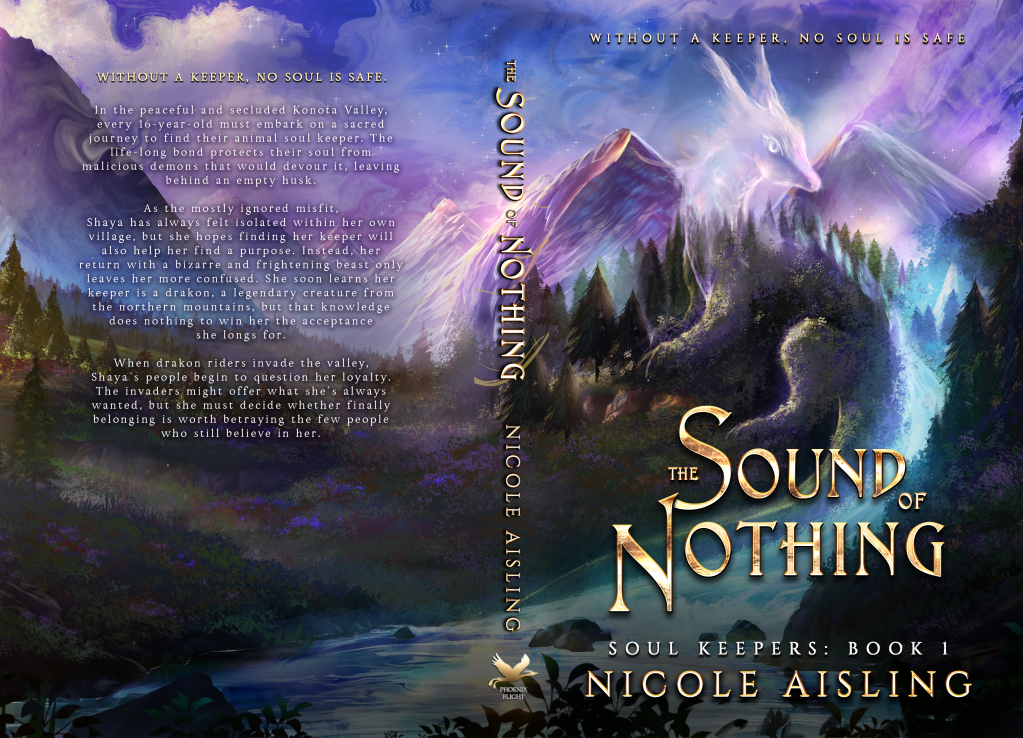
I’m so pleased with how it turned out and can’t wait to start working on the next book in the series!
Dream ✨Imagine ✨ Believe
I finally have a full paperback cover to share with the world! Didn’t JV Arts do a fantastic job?
I’m so pleased with how it turned out and can’t wait to start working on the next book in the series!

Subscribe to get access to the rest of this post and other subscriber-only content.
Subscribe to get access to the rest of this post and other subscriber-only content.
Subscribe to get access to the rest of this post and other subscriber-only content.
If you don’t follow me on social media, you might not have seen me plastering the cover all over the internet. So here it is: the official cover for the Sound of Nothing! It took far too many months to become a reality, but it was so worth it.

Blurb:
Without a keeper, no soul is safe.
In the peaceful and secluded Konota Valley, every 16-year-old must embark on a sacred journey to find their animal soul keeper. The life-long bond protects their soul from malicious demons that would devour it, leaving behind an empty husk.
As the mostly ignored misfit, Shaya has always felt isolated within her own tribe, but she hopes finding her keeper will also help her find a purpose. Instead, her return with a bizarre and frightening beast only leaves her more confused. She soon learns her keeper is a drakon, a legendary creature from the northern mountains, but that knowledge does nothing to win her the acceptance she longs for.
When drakon riders invade the valley, Shaya’s people begin to question her loyalty. The invaders might offer what she’s always wanted, but she must decide whether finally belonging is worth betraying the few people who still believe in her.
Subscribe to get access to the rest of this post and other subscriber-only content.
I see people compare Simba’s Pride and Romeo & Juliet all the time, often with a negative connotation like “Lion King is just Hamlet and Simba’s Pride is just Romeo & Juliet” like that’s a bad thing. First of all, there are endless books and movies based on Shakespeare plays that are excellent. Not to mention the plethora of fairytale retellings that are so popular right now. So even if that movie was the exact same plot as Romeo & Juliet, that wouldn’t be anything to snub at.
… except it’s not.
Yes, Simba’s Pride is about two characters from warring families and tragedy ensues because they fall in love. That’s about where the similarities end.
So let’s talk about the differences between these two stories and why labeling anything with starcrossed lovers is kind of short-sighted and makes me feel like you haven’t actually read Romeo & Juliet.
Obviously there will be tons of spoilers for both stories below, so if for some reason you aren’t familiar and don’t want the whole plot spoiled… stop reading.
So… yeah. If feuding families + romance = Romeo & Juliet, then the Lion King 2 is just that. It’s a pretty shallow assessment if you ask me.
Top 10 songs for Chasing Nightmares
Subscribe to get access to the rest of this post and other subscriber-only content.
For those who don’t already know, Chasing Nightmares has a character with aphantasia, a phenomenon where people are unable to visualize images voluntarily. I share this “condition,” something I discovered only within the last year. I wanted to put something up on here for people who are curious about what that is and how it affects people who have it.
I didn’t even realize this was a thing until I saw a post on social media about it. I went through college with a psych minor and somehow never realized that when people talked about “visualizing” something they were actually able to see it in their head like it was real. Learning that people are capable of this… blew my mind.
I think a lot of people who have it doesn’t realize they do, because they’ve never even heard about it before. You don’t realize other people can do what you can’t. I’m hoping that this character will reach people who are unaware that they experience this phenomenon, perhaps resonate with them, and help them learn something about themselves. Because once you know, a lot of things start to make sense.
I don’t choose to see it that way, but it can affect my life in some detrimental ways. For one, I experience something called Severely Deficient Autobiographical Memory (SDAM), which is the inability to vividly recall personal events. I’ve talked to some people who describe “rewatching memories,” almost like a movie playing out in their head. This absolutely baffled me, since all I see when I close my eyes and try to think of a memory is darkness.
My inability to replay memories can make it difficult for me to recall any details at all. I’ve always had a hard time remembering events that happened to me, and I think many of my “memories” are secondhand products of people telling stories about events where I was present. I don’t personally remember it, but I can remember the story. I have very few memories from my childhood that I believe are actually my own recollection, not someone else’s description.
I also have a hard time recognizing and remembering faces, since I can’t visualize them, which partially explains why I struggle to recall names. If I don’t have a face to match it with, how am I supposed to remember one’s name? I’ve been approached by people who seem to know me, but I can’t for the life of me place who they are, which is an incredibly awkward experience.
After learning about this condition, I did a bit of a deep dive into the internet. A lot of people with aphantasia fall outside the creative spectrum… but not all. It makes sense that people who can’t visualize wouldn’t be interested in becoming artists or directors. Or writers. Despite this, there are actually a surprising number of artists, writers, and other creatives with aphantasia. People like me.
Some people with aphantasia have said they don’t understand the appeal of reading fiction because they can’t visualize what’s happening. Meanwhile, I was an avid reader as a kid and wrote my first novel in middle school. Apparently, the inability to literally play out the scenes in my head didn’t impact my desire to create stories. But I do think it impacts how I create stories.
I’ve always known have a tendency to under-describe things. A lot of times when I get to a part of a book where I need to describe a setting or something else in detail, I’ll mark it and come back to it later. I have to force myself to describe things like that, because if it’s not super important to the scene, I don’t care about it. I can’t see it in my head, so why do the details matter? I also give very minimal descriptions of my characters. Hair color, eye color, ethnicity, sometimes height if it seems relevant (if they’re very tall or very short). Finer details don’t matter to me. I’ve heard people talk about never being satisfied with adaptation casting because it never matches the image in their head, which until last year I couldn’t understand. I rarely took issue with casting as long as they matched the description given by the book. Sometimes even if they didn’t. Why do we care if someone’s eyes are blue instead of green? Now I’m realizing people have an actual image in their head for these characters, and it’s slightly different for everyone. So trying to fit a real person to that would be difficult.
People with aphantasia have to deal with facts and concepts in their heads instead of visuals. You might be able to visualize an apple in all its red, shiny glory, but I only have associations. I know an apple is red, or sometimes green. I know if the light hits it the right way, it has a sheen. It might have a stem, perhaps a leaf. I know all of these things. But I can’t see it. When I imagine scenes for my writing, I make a list of details in my head. I know my character is going to do or say this thing, but I can’t see it.
Let’s get back to Chasing Nightmares and the character who experiences aphantasia. If you haven’t read the book, there will be some minor spoilers ahead, so please consider reading it before you continue.
Cat Knight has aphantasia. She’s known something was different about her for a long time, though I don’t think she had a name for it until she was a teenager.
If you have read the book, here are some things you may or may not have picked up on:
Want to see more of Cat? Shattered Daydreams, Dreamscapers Book #2, will explore some of the other ways Cat’s aphantasia impacts her life, both good and bad.
 Nicole Aisling - Author