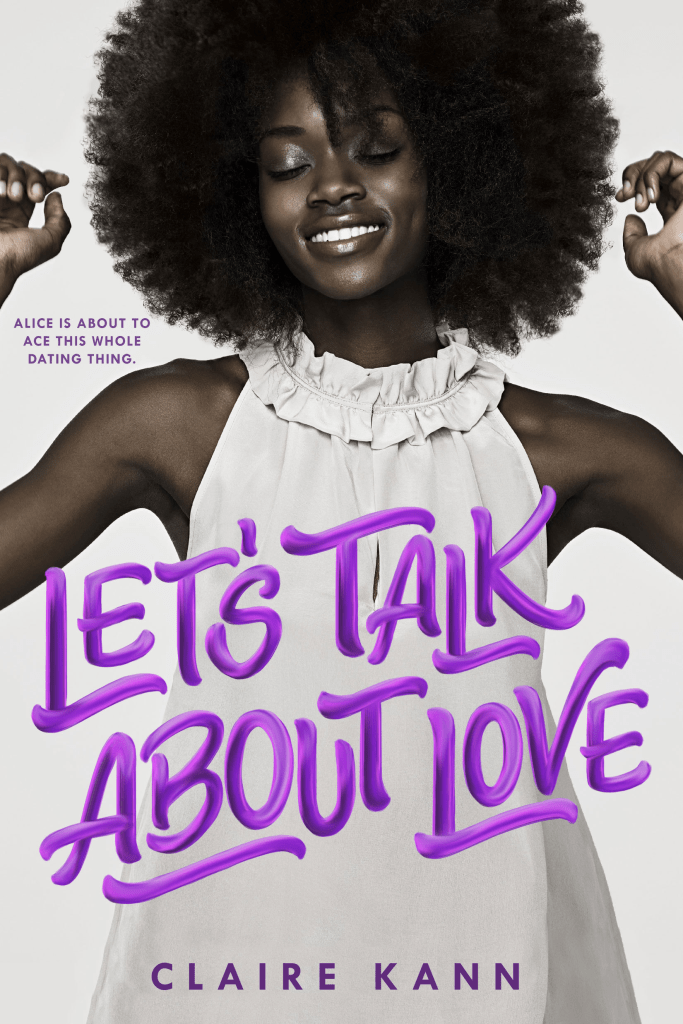
Let’s Talk About Love by Claire Kann (3/5)
This book is technically a two stars for me, but I added one because contemporary romance is usually not my genre. I read it because of the ace rep. There are a lot of angry reviews out there from other ace-spec people, and I’m relieved to say that I’m not one of them. There are some things I find concerning, but we’ll get there.
The Plot
The plot of this book feels like your typical romance. Girl meets boy. Girl likes boy, and boy maybe likes girl too. But neither tells each other that because people don’t talk to each other. The thing that makes it less typical is the asexuality of the main character. They tell us right from the start that she’s asexual. Her girlfriend breaks up with her in the first chapter because she doesn’t want to have sex. Not because she won’t, but because she doesn’t actually want to. Most of the book is mundane bonding interactions between the leads, with some drama between Alice and her friends thrown in. There’s also a conflict with her family about her not wanting to go to law school. I find this type of plot boring, but it might interest someone who likes cute, low stakes contemporary romances.
The Characters
Alice: Our protagonist is childish, awkward, and theoretically “cute,” although I’m not enamored with her. This might have something to do with the narration style more than Alice herself (more on that coming soon). Her personality is pretty much confined to pizza, TV shows, and… maybe books? She works in a library but I don’t remember her ever talking about liking to read books. She’s joined at the hip with her two best friends, who are dating each other. I feel like her being ace is brought up far too often, compared to her other identities as a biromantic black woman, but given the theme of this book I’ll let it slide. But for the record, I’m ace and I don’t spend nearly as much time thinking about being ace as she does.
Takumi: The love interest in this seems like a good person, but a somewhat boring one. Kind, thoughtful while expecting nothing in return, and apparently the prettiest person on the planet. I probably would like spending time around him in real life, but his character didn’t interest me.
Feenie: I strongly dislike Feenie, not because of her basic character traits necessarily, but the way she treats her best friend. I had a friend that was far too close to Feenie’s personality for comfort, and it went about the same way as this friendship, minus the make-up. Honestly, I wanted more from the “apology” between them. If you ask me, Feenie’s side of it was half-assed and too readily accepted. She basically said “I know I can be an asshole sometimes, oops.” But showed no intent to change the way she treats Alice, which was essentially ignoring her in favor of Ryan (Feenie’s boyfriend) and then getting pissed when Alice tries to form other friendships. As someone burned by a possessive friendship like this, it bothered me. There was a scene at a party–that Alice got talked into going to–where Feenie and Ryan go off to have sex and abandon Alice on her own, so she leaves with Takumi. Am I the only one who doesn’t see an issue with her choice to leave? I would have been livid if my friends abandoned me at a party I didn’t want to go to in the first place.
Ryan: Feenie’s boyfriend and Alice’s other best friend–in that order. He seems like a generally likeable person, but he has some of the same issues Feenie. He doesn’t hold a grudge quite as fiercely as his girlfriend, but he still acts like Alice paying attention to anyone but the two of them is blasphemy.
The Writing Style
This gets it’s own section because I hated it. It’s not the first time my opinion of a book has drastically dropped because I disliked the writing. I found the constant use of parentheses distracting and quite frankly annoying and childish.
(It’s partly because they were sentences on their own line inside parentheses for no reason I can see.)
(Multiple lines in a row like this. What’s the point?)
It happened almost every page and I just… really, really didn’t like it. You’ll notice I put stuff in parentheses several times in this review. Now multiple that by 5 and you have the narration style of this book.
The Ace Representation
The main character of Let’s Talk About Love is asexual and has known it for a while, though she’s not great at telling people. Only her best friends know, rather than… you know, her partner. She doesn’t even really tell her ex-girlfriend when they’re breaking up. I understand the fear of confessing this to the person you’re dating, since sometimes (often…) it can end in a break-up, because sex is something allosexual people want in their relationship. I don’t think there’s anything wrong with that, even if it is frustrating and heartbreaking for the asexual person. Alice spends most of the book avoiding talking to Takumi about her feelings for him and her asexuality, which is the source of the main conflict.
The Good: Some of the ace rep is actually very good. This book talks about what exactly ace means, the fact that it’s a spectrum, and how romantic attraction can be separate from sexual attraction. There are several scenes that hit painfully close to my own experiences/fears. I think it’s important to have that information out there, for people who don’t even know asexuality exists.
The Bad: As previously acknowledged, asexuality is a spectrum. Ace-spec people can range from sex repulsed to enjoying sex but not requiring it as a fundamental part of their romantic relationships. I think Alice falls somewhere in the “not sexuality attracted to people but doesn’t absolutely hate sex range.” She just doesn’t care about it. My main issue with the ace rep in this book happens when Alice first meets Takumi. She experiences arousal for the first time, and then freaks about because she doesn’t know what that means for her asexuality. They later try to explain this away as “arousal and sexuality attraction are different.” I’m not an expert (as I’ve never experienced it), but wouldn’t being aroused by a specific person be sexual attraction? Someone correct me if I’m wrong.
I’m not saying this couldn’t be someone’s personal experience, but it plays dangerously into the ridiculous insistence that asexuals “haven’t met the right person yet.” The fact that Alice has never experienced this reaction to someone, and then Takumi walks in and, ope the “plumbing is on.” After this, the book holds true to Alice’s lack of desire for sex, regardless of her reaction to Takumi, but it felt so unnecessary and far too close to something most asexual people have heard too many times. Why not just have her completely not experience that reaction in response to other people? Especially when there’s so little ace rep out there. I would be more okay with it if more examples existed, so we could get a broader spectrum, but in the meantime I think it’s best to stay away from ideas that perpetuate misconceptions.
My other (smaller) concern has to do with Takumi being allosexual and accepting that his relationship with Alice might never involve sex. Again, I’m not saying this couldn’t happen, but it’s unlikely. Most people who want sex… want sex in their relationships. Like many romance stories, it sets unrealistic expectations and needs to be acknowledged. Many of us romantically-inclined ace people dream that someone might love us enough to give up sex, but the sad truth of it is most wouldn’t.
Conclusion
So… did I like this book? No. Did I hate it? Also no. I didn’t like the main character or the writing style, and I’m often bored by contemporary romance, but I don’t think it’s a bad book. It has some questionable moments and some of the asexual representation makes me uncomfortable, but I still appreciate there being a book out there that brings asexuality onto people’s radars.
As a side note, I haven’t been able to diagnose whether the author is on the ace spectrum. I’ve read interviews that are super vague about it, even though this book is listed as #OwnVoices. I know that people aren’t obligated to share their sexuality with the public, but when you’re writing a book about asexuality… I feel like it becomes the exception. I strongly believe if you’re writing a book that is focused on a specific identity, you should share that identity (having an ace main character is different than a book about being ace). If anyone has found a concrete answer one way or another, please let me know.

 Nicole Aisling - Author