But Nicole! Twilight is a fantasy novel. Why are you bringing science into this?
Well, because Stephanie did. Or tried to.
I understand the impulse to explain magic by tying it to science, but if you’re going to do this, please do the research. This is such a brief part of Breaking Dawn (one chapter!) that it didn’t even need to exist, but it still managed to annoy me.
For those who haven’t read the book or don’t remember, Carlisle and Jacob spend a few paragraphs talking about chromosomes. Specifically, the fact that vampires and werewolves have a different number of chromosome pairs than humans. Humans = 23, werewolves = 24, vampires = 25.
Let’s start off ignoring the fact that getting turned into a vampire means you gain two extra pairs of chromosomes and focus on the faulty reproductive aspect of this. For vampires it matters less, since they’re not supposed to be able to reproduce anyway, but werewolves are another matter. If they have 24 chromosomal pairs, they would only be able to reproduce with other werewolves, lest they produce infertile offspring. The reason this is problematic is the same reason mules are usually sterile. A mule is a cross between a horse and a donkey, two species that have a different number of chromosomes. The resulting mule has an odd number of chromosomes (63), which disrupts the process of meiosis.
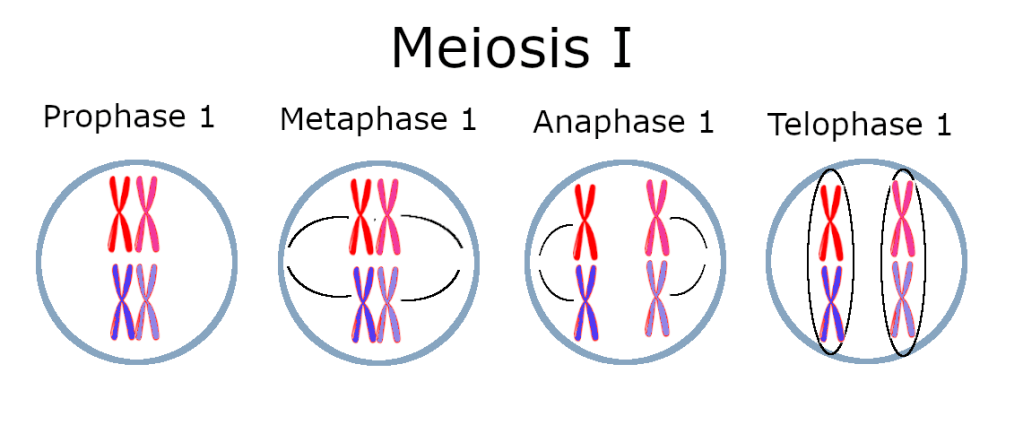
To really explain this, we’re going to delve deeper into genetics and molecular biology. You may remember meiosis and/or mitosis from biology class. Mitosis is how cells replicate themselves, producing an identical cell with the same number of chromosomes. Meiosis, on the other hand, is how our bodies made sperm and eggs, also known as gametes. We inherit half of our chromosomes from each parents, which means gametes need to have half the number of chromosomes, lest the offspring end up with way too many. During meiosis, chromosomes line up with their pair so they can be separated, producing cells that have only one set of chromosomes instead of two. The fact that mules have an odd number of chromosomes means that last chromosome doesn’t have a pair to buddy up with. This prevents meiosis from being successfully completed, and therefore mules have no sperm or eggs.
So how does this relate to werewolves? Since Meyer makes a point that most werewolves are male (Leah being the exception, blessed her poor tortured soul), it means that werewolves reproduce with humans. The result would be a child with an odd number of chromosomes (remember, humans have 46 chromosomes and werewolves have 48), and therefore they would experience the same reproductive problems as mules. They would be a genetic dead-end and werewolves would cease to exist.
As for the vampires, apparently drinking their blood and then dying somehow infects you with two extra pairs of chromosomes that infiltrate all of your cells and that turns you into a vampire. Vampirism would have to be a virus that can insert itself into your genome, those chromosomes carrying genes that can bring you back from the dead and allow you to exist without a heartbeat or blood.
Wait, did I just explain vampirism? Okay, Stephanie, I’ll give that one to you. But the werewolf thing still doesn’t work.
Update: I forgot to mention that Edward and Bella’s hybrid baby would have 23 pairs and 2 unpaired chromosomes, not 24 pairs as Carlisle implies. It’s an important distinction.

 Nicole Aisling - Author
One thought on “Bad Science: Breaking Dawn”