The Long Way to a Small, Angry Planet by Becky Chambers (4/5)
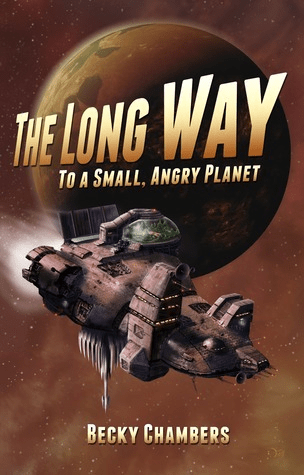
I was pleasantly surprised by this book, which I read because a friend recommended it. Space opera is usually not my go-to genre, though I wouldn’t say I dislike it. I enjoyed the (original) Star Wars movies and some other works in the genre, but it’s not something I seek out. I mention this because my review is from the perspective of someone who does not read widely in the genre.
Quick Spoiler-Free Review
Honestly this whole analysis won’t contain huge spoilers (there really… aren’t that many to give, as this book didn’t have much of what I would call “twists”) but I wanted to give a “should you read this book?” before I dive into it.
It boils down to World Building > Characters > Plot. If you read for the first two, you’ll probably enjoy it. If you enjoy a more plot-driven story, this will probably bore the hell out of you.
The Premise
The Long Way to a Small, Angry Planet is set in the distant future, where many different sapient species have formed the Galactic Commons, or the GC. The alliance seems overall like a decent organization, rather than the corrupt, over-bearing governing body I sometimes expect to see in futuristic worlds. They have their faults and are clearly driven in part by greed, but they don’t do anything overtly horrendous.
The Wayfarer is a tunneling ship, which basically punches holes through space to connect distant points to make interstellar travel faster. Physics is not my forte, and honestly their actual job is only important at the beginning and very end of the book, so we’re going to leave it at that. They’re hired for the job of a lifetime, a “long haul” worth a lot of money, and thus they start their very long journey to a small, angry planet….
The World Building
This has to be my favorite part of The Long Way. The thoroughness of thought that went into building the different alien species is wonderful to see. They have unique and intriguing biologies and cultures that, for the most part, were introduced with enough grace that it rarely felt like info-dumping. Some had more development than others, with more attention focused on the species that made up the Wayfarer’s crew (which makes sense). I won’t go into immense detail about all of them, but I wanted to highlight some aspects of certain species that I really appreciated.
Grums: This dying species has a tragic story that I fear is the fate that awaits humanity (real humanity, not the humans in this book). They killed each other to the point of near extinction, and I’ve inferred that no females of the species remain, though I don’t think it’s ever outright stated. Our Grum character implies that their species will die out, but this could be related to simple lack of numbers or a collective agreement to stop breeding. They have a fascinating life cycle, where they are born female and transition to male later in life, a feat of biology that is indeed present in some species found on earth (mainly certain types of fish, though perhaps others I’m not aware of). I love seeing these quirks of nature worked into fictional species. They also have interesting vocal cords that let them make more than one sound at once, requiring them to develop the skill of synchronizing their vocals to speak the human language.
Sianat Pairs: The defining characteristic of Sianat Pairs is that they have this virus that infects their mind, with some beneficial results. So beneficial that it has become a part of their culture and religion, and those who refuse the disease (or cure themselves of it) are considered heretics. The Whisperer, as they call it, enhances their minds so they see the world in ways others cannot, and it allows Navigators like Ohan to guide tunneling ships through the sublayer. Unfortunately, it also chops a solid century off their lifespan.
Aeluons: The main aspect of this species that I loved was their means of communication. They lack any natural ability to hear (which is never explained in evolutionary terms, something that disappointed me, as someone who loves evolution) and their major form of communication amongst one another is through their cheeks turning different colors. This is simply so unique and creative that I had to include it. They use technology to “hear”/communicate with other species.
Aandrisks: Their society more than biology is what’s fascinating about these beings. Described as being lizard-like in appearance (though referring to them as “lizards” is a slur), their culture is vastly different than humans. They are a promiscuous species (and I don’t mean that in a derogatory way), forming relationships with many others that likely won’t last the rest of their life. They aren’t raised by their biological parents, but rather a “hatch family” of elders who have decided they are ready to settle down and raise children. Then they choose their own “feather family,” made up of chosen others who they may or may not have a sexual relationship with. Essentially, their society is built around found family. They are extremely affectionate and lack anything resembling modesty, perfectly happy to “couple” out in the open.
The Characters
I really enjoyed the varied cast of the Wayfarer. Even other characters we meet along the way seem to have rich lives outside the orbit of the main plot and the central characters, which is what makes supporting characters feel real. Most of the crew isn’t lacking in personality and backstory, though most of them do fall short in terms of actual arcs and growth.
Rosemary (The Clerk): The actual main character of the story, Rosemary lands somewhere in the realm of a mediocre character for me. She has an interesting backstory that is hinted at (without any particular subtlety) and later confirmed. She seems like an intelligent, generally kind, and likable person, while still showing her own flaws, yet she never read with much real depth for me. She wasn’t a Mary Sue, but nothing made me fall in love with her.
Ashby (The Captain): Ashby the human has to be one of the least interesting characters in the story (other than Ohan, but that’s because they don’t get much page time), but he does serve his purpose. Ashby is a good captain, dedicated to his crew and their safety. He’s understanding and willing to listen, but firm and commanding when he needs to be. Unfortunately, Ashby lacks any characteristics that would make me attached to him, beyond perhaps a defining moment at the end where he tells the Parliament off for their short-sighted treaty. Compared to other complex captains in the genre (like Mal Reynolds) he’s simply okay.
Sissix (The Pilot): Our reliable Aandrisk pilot is one of the more openly emotional and affectionate characters. She’s courteous and goes out of her way to respect the customs of other species, while sacrificing her own needs. She loves the crew of the Wayfarer that has become her feather family, but they don’t fulfill the same needs an Aandrisk family would, which I imagine her mental health suffers for.
Ohan (The Navigator): Ohan is a Sianat Pair, and they might be the most interesting species and least interesting character. We just don’t see them for most of the book. They’re aloof by nature, which means you either don’t get to know that character or you force them into situations where they have to interact. Chambers chose the former.
Corbin (The Algaeist): Again, we don’t see as much of the anti-social Corbin as some of the other characters. He tends to the algae vats that… apparently the ship somehow runs on? I don’t know if this is existing/theoretical technology, but it’s never explained in any detail. Most of the crew dislikes him, especially Sissix, but he’s good at his job so they tolerate him. He has a bit of a character arc but it could have been a lot more captivating, given more attention.
Dr. Chef (exactly what he sounds like): Honestly, Dr. Chef is the character I most want to hang out with sometime. The Grum chef/doctor is pleasant company, offers comfort and wisdom when needed, loves food, and seems to be a deeply thoughtful person. I’d let him cook for me anytime, though I am dubious about these insects they eat. Just remove it from the shell first and I’m fine, kay thanks.
Jenks (The Comp Tech): Jenks is the kind of person any of us with limited self-esteem might aspire to be. He seems rather confident in his own skin, without any need to fix any shortcomings (sorry, I had to do the pun). His one Big Problem is that he’s in love with the ship’s AI, who thankfully loves him back, but this love comes with obvious issues for the two of them. While I recognize Lovey (the AI) as a person in her own right, she’s not getting her own section in this because her character is entirely tied to Jenks. She seems pleasant and helpful, as any good AI ought to be, but lacks any personality beyond the relationship she shares with the computer tech.
Kizzy (The Mech Tech): Oh, Kizzy. Sweet Kizzy. I knew I would love her from when she first stepped onto the page. She’s hyper, talkative, occasionally vulgar, often rash, and maybe a bit ditsy (she did drop a sandwich in the engine that one time). Above all, she has personality. She has flair. She’s full of life and love and makes mistakes and deals with self-doubt. I enjoyed every moment of Kizzy’s existence and wish only the best for her.
Ultimately, it’s the interactions between the main characters that I loved more than the characters themselves. Except Kizzy. I love Kizzy. The wholesome friendship between Kizzy and Jenks, the way Ashby and Sissix support and rely on each other, the hesitant development of something romantic(?) between Sissix and Rosemary. Even Corbin’s place amongst the crew, which is basically everyone hates him, is a dynamic that is brilliantly utilized when the other characters pull together to save him. They’re a family, and sometimes you can’t stand your family, but you’d do anything for them anyway. This is really a major (if not the major) theme of the story.
The Plot
So this is where this book lost a star from me. The story is heavily character-driven, which is usually okay with me, but this plot is so almost non-existent that it came close to losing me a few times. It’s a disjointed series of events that really don’t connect to each other at all, making it feel like an “adventure of the week” TV show episode rather than a linear plot. You could have switched up the order of 50% of the events in this book and it wouldn’t have changed the story. They make stops along the way to their destination, each of which tends to showcase a character (or a few) and result in some character development. There’s nothing inherently wrong with this, if you’re into that kind of thing, but I prefer some more continuity in my plots.
Final Thoughts
The main thing that kept me reading was the intricate world-building and curiosity surrounding the characters. The little isolated plot adventures were fun, but lacked the cohesion that tends to pull the reader from one chapter to another, and I never got that I’ll read just one more chapter feeling. However, I did thoroughly enjoy reading it anyway.
Also, it made me cry. Like a lot. Not heaving sobs but frequent water leaking from my eyes and lots of tissues needed. So, thanks for that Becky.
Final Note: It bothered me that Human was capitalized. That had to make it into this review somewhere. It’s a species, not a nationality. Exodans being capitalized makes sense, but you wouldn’t capitalize dog or horse or fish. By that logic, Aandrisk, Grum, and any other alien species shouldn’t have been either. I feel like fantasy and sci-fi authors feel the need to capitalize anything foreign or important sounding, so Human got capitalized along with the other aliens for consistency.

 Nicole Aisling - Author